Tuesday, January 27, 2009

Every Season Has Its Firsts


Even in the oddest of seasons, there always seems to be a few things that stand as interesting, unique or as a 'first'. After decades of hunting you would think that you've pretty much seen it all, but it never fails that each and every year there is something that causes you to pause, tilt your head to the side and give a verbal "hmm".

Here are a few of the things that made the 2008-09 duck season memorable.

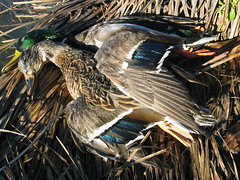
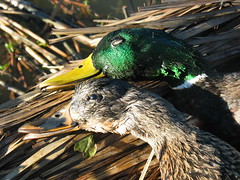
One of the early firsts was the duck with a $100 reward band. Hunting can pay! That was the same day as out limits of greenheads on opening weekend. Special for sure.

That was cool, but then myself, The Hunting Partner and Uncle rented an airplane to scout a hunting area. I think we've really lost our minds.

There was also a special interview with one of my favorite wild game chefs, Scott Leysath. It was cool to hob-nob with the rich and famous. At least I pretended to hob-nob. It was actually just hanging out in his living room interviewing him.

Scott has some great recipes in his cookbook, one of which I used to cook my first scotch double on mallards. Pan seared duck with bourbon cream sauce. Yummm. That's not to be confused with the special recipe he made just for Hunt, Eat, Live!, which also included bourbon. I'm beginning to see a trend here.

There was also the first time that I was able to introduce hunting to an adult, and he then went on to shoot a Eurasian Wigeon as his third bird of his short hunting career. See if I ever take him out again.

The weather, or lack thereof, tops the list as the most interesting aspect of the season. We've experienced years of weather extremes in the past, but this had to be one of the oddest weather years ever. Frustrating one minute, wonderful the next. But mostly just frustrating.

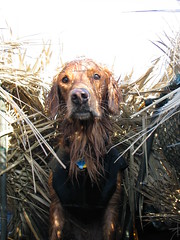
It is these interesting aspects of the waterfowl season that will keep me coming back next fall. That plus the good fellowship, time connecting with my food source, time with friends and Max the dog. It is the accumulation of these wonderul memories and reliable firsts that are the reasons why I hunt, eat, and live!

Sunday, January 18, 2009

An Uncommon Visitor

A couple months ago I wrote about The Friend who had decided that he wanted to try duck hunting. Although we’ve had an unusually poor season due to a lack of weather, it has been a real privilege to introduce him to the sport and teach him all the basic ins and outs.

Today we made plans to go out and see what the fair weather would bring us. If nothing else, we’d have a nice boat ride, see a beautiful sunrise, and enjoy each other’s company. The Friend has been out with me and the Hunting Partner several times throughout the season and up to this point had harvested one spoony and one green winged teal. A little thin to keep his interest high, but he was having a good time learning the ropes nonetheless.

As expected, it was a beautiful, cloudless, sunrise and as the time passed without many ducks working our spread I helped The Friend with some calling basics. If you were a fly on the wall (or in the blind as the case may be) you would have laughed at the verbal descriptions I was using to try and verbalize what you say into the call to get the correct sound.

“No, no. It’s more like ‘HUT, HUT, Hut, Hut, hut,’ not ‘Hut, HUT, Hut, hut, hut’ for the hen mallard.”

“Say ‘Hoo-whee-hoo, hoo-whee-hoo’ into the call for the Wigeon.”

“Use that thingamajigger in the back of your throat to help with a proper feeding chuckle.”

It was quite funny at times and I am sure the other hunters in the area were getting their own chuckle at the squeaks and cronks emanating from our location.

Anyway, I digress.

As we sat there basking our faces in the warm morning sun, The Friend noticed a duck coming in low and fast directly to my right, parallel with the boat. By the time I caught the movement out of the corner of my eye I could see that this duck was just going to zip right in and sit down in the decoys.

Where we were hunting there were hundreds of Canvasback, which are on the Federal “do not touch” list this year due to population concerns. All morning we had been taking extra time to properly identify those birds that showed some interest in our setup, with the result often the same. “Never mind, it’s a Can.”

But by the time I saw this duck coming straight at me, I spied a short, baby blue bill and rosy chest and knew right away; game on.

“OK – it’s a Wigeon. I want you to shoot this duck. I’m not going to stand up, so it’s all you.” As the bird slowed to land, I told The Friend, “Shoot it!”

He stood and readied himself, but the bird skirted in and got on the water before he was ready. We both sat there for a split second, expecting the duck to immediately survey the situation, see the man standing with a large, black metal tube pointed in his direction, and rise to get the heck out of Dodge.

As quickly as the duck entered the situation, he decided to leave and rose from the water as expected. As he gained space between himself and the water, The Friend’s smooth bore reported and the duck again returned to the water. This time he was lifeless.

Max did his thing and lurched into the water for the retrieve. However, as he grabbed the duck and began to swim back to the boat I caught an unmistakable glimmer of cinnamon color reflecting off the duck’s head.

‘Oh, crap!’ I thought to myself. ‘It’s a Canvasback’.

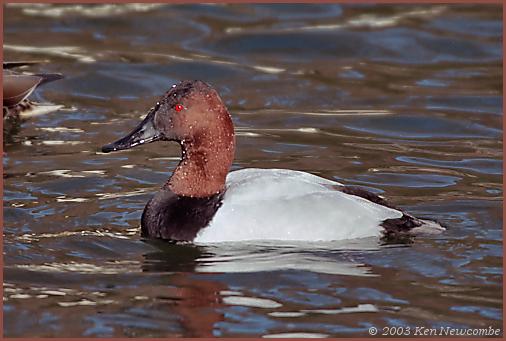
But as I replayed the preceding scene in my mind again, I knew, just KNEW, that the duck I saw on the wing had to be a Wigeon. Cans are so easy to identify - big white, round body, flaming red head, ginormous beak. I just couldn’t believe I had mistaken the two. Could it be that my mind is playing tricks on me and I wanted that duck to be legal so The Friend could get another chance in the closing weeks of the season?

As Max made his way back to the boat, I noticed he had grabbed the duck by the butt and as he swam closer I could see more, and more of that cinnamon head. But as got within a few yards I could begin to make out more details and again saw that unmistakable blue beak.

“What the heck is it?” I said to The Friend. Then is dawned on me. Could it be?

Yes! Indeed, as Max dropped the bird in my hand, I turned and held it up and announced, “Eurasian Wigeon!”

What a treat, particularly for The Friend. I have seen forum posts over the years with hunters who have harvested a Eurasian. And it was last year that I was with The Hunting Partner when he shot his last bird to fill his limit and it was a Eurasian. But to see such a rare bird is special. The Friend and I exchanged high-fives and I began telling him how special this specimen was.

***

Eurasian Wigeon are a rarity among North America waterfowl. Annually there are sporadic sightings and harvest reports along the upper Pacific Coast and Eastern Seaboard. However, they are not native to North America and there is no known breeding population. Eurasians that do make their way into North America come from Siberia or Iceland. On the Pacific Coast it is rare to see one south of Washington State.

Eurasians are one of three types in Wigeon family; American and Chilöe being the other two. American Wigeon are, well, common around here as you would expect. In the Pacific flyway we harvest a lot of American Wigeon. They love to infiltrate the northern California rice field duck clubs where we shoot. Routinely American Wigeon will make up a good portion of a rice field hunter’s bag.

There are no reports of Chilöe Wigeon being spotted or harvested in this area. They inhabit the lower section of southern South America. Although if a Eurasian can get lost and fly to Northern California from Siberia, well then I suppose it is not outside the realm of possibility that a Chilöe could end up here as well.

***

We wrapped up the day talking as excited as school girls about what type of mount The Friend would order to preserve the memory of his rare find. This bird is proof that the duck Gods have a terrific sense of humor. How else can a brand new duck hunter who has only killed two birds in only his first year end up with such a great bird.

As we motored back to the dock, The Friend turned and with a big smile on his face, said “Now that will keep me coming back for a long time.” So true my friend, so true. This is why we live to hunt!
Tuesday, January 13, 2009

Doing the Rain Dance

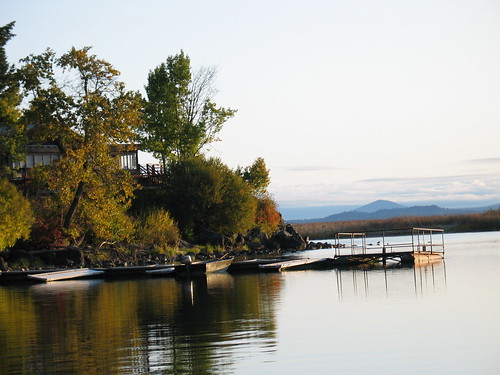
Oh, the weather outside is… beautiful, sunny, warm, dry. Yesterday the thermometer topped out at 74 degrees. Not exactly what you hope for in the middle of what should be the best waterfowling weather of the season.

This year’s duck season has felt like an absolute roller coaster. One minute we’re complaining because there is no weather and no ducks. The next we’re singing the praises of arctic fronts blowing through and providing wonderful waterfowling action. Now we’re back to complaining. The weather has returned to mid-Spring conditions without the prospect of a drop of rain or snow anywhere in sight.

What is an ongoing irritant for a poor waterfowling season has begun to have larger, more serious consequences. The water conditions in California are downright scary. Coming out of Spring 2008, the snow pack was 24% of average and only 3.4 inches of rain had fallen in the lower regions. Reservoirs were draining faster than they were filling.

By the end of summer most reservoirs and lakes were at record low levels and the State of California declared a major drought for the second year in a row. According to the California Department of Water Resources,

"California is facing the most significant water crisis in its history. After experiencing two years of drought and the driest spring in recorded history, water reserves are extremely low."

So what does this have to do with hunting? Well, no water equals no habitat. No habitat equals no breeding grounds. No breeding grounds equals no breeding. You get the picture. And Northern California counts on a large number of locally grown ducks, particularly mallards, which fill hunter’s bags for a good portion of the waterfowling season.

Additionally, the lack of water combined with a faltering economy and subsidy programs led to a moderate growing season of Northern California’s most important crop – rice. The result is that fewer acres were planted than we’ve seen in over a decade. Rice acreage is critically important for rearing and fueling local breeding mallards.

These same acres are equally as important in the Fall as rice farmers count on flooding rice stubble and leasing those acres to duck hunters for supplemental income and the ducks count on the residual grain as a major winter food source.

Due to water rationing, we have had fewer of those already limited acres flooded this Fall. A large number of hunters lease duck blinds in rice country for an average of $6000 per blind. So the consequence this year was that most rice field duck clubs experienced delayed water deliveries, and in some cases, no water at all.

Yup, believe it or not I had a fellow hunter tell me that the water district that provides water to his club informed the farmer that there would no water this year at all. And there is nothing anyone could do about it. There is simply not enough water to go around. Nobody wins.

I wrote here about my own challenges with our duck club being three weeks late with water. Fortunately we were lucky to get some water, but the water district limited the duration to two weeks instead of the normal thirty days before they shut off the pumps. From then on out we depend on Mother Nature and steady winter rains to keep the fields topped off until the season wraps up at the end of January.

This year that simply has not materialized. Rice fields are drying up all over the Valley and by this time next week our own decoys will be laying on their side in the mud. Ducks don’t hang out in the mud.

What makes me nervous about the beautiful weather we’ve been experiencing is that it will be compounding what is already a very difficult situation. I shutter to imagine what next Fall will bring if the water conditions do not change before the Spring thaw, if there is anything to thaw.

So if you know of an effective rain dance, could you send it to me? If it works, I’m offering a guided duck hunt and all the fixings. Oh, and I’ll even throw in a hug.

Sunday, January 4, 2009

Make Mine a Double... A Scotch Double


I was a little apprehensive heading into last Saturday’s waterfowl hunt. After all, I was coming off of a terrible day of gunning Friday in which myself and my two blind mates eventually ended up pulling limits of birds on stormy morning hunt. But just suffice it to say that it was not my most stellar shooting days. I believe at one point there was some smart-ass comment from the other end of the blind referring to my shooting, a barn, and its broad side.

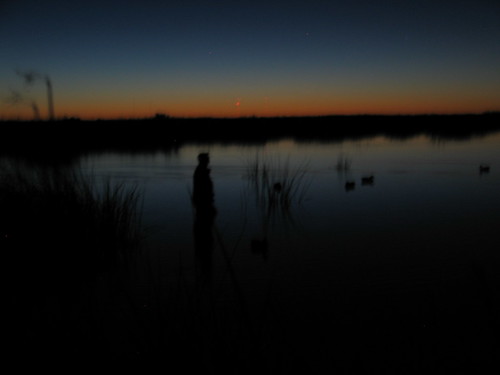
Anyway, Saturday began as usual. Up at 2:30 am, pick up The Hunting Partner, at the boat dock at 4:00 am, and then motor out to the hunting site and set up decoys by 5:45. Satisfied that our honey hole was secured, we sat back and toasted the clear, cloudless black sky by tracking satellites and counting falling stars with a cup of java.

As dawn broke and shooting time approached, we noted that the breeze had picked up to a steady north wind of 10-15 mph. A perfect setup for our blind on the north end of the pond. With the wind to our backs, we knew the ducks should work nicely up from the south and into the lure of our open section of the decoys directly in front of the boat.

Shortly after shoot time we were rewarded with the first group of mallards that wanted to join their plastic brethren. A group of five worked around the pond a couple of times and, on the last pass over us, one of the drakes broke loose and made a B-line for our position. At 20 yards The Hunting Partner and I stood simultaneously and he fired, striking the duck. A quick follow up from my Benelli assured that this fine specimen would end up in the freezer.

A few other groups of ducks would arrive on scene and worked our spread with similar results. But it was the last group of the morning that would prove to be extra special.

A mixed flock of six birds – 4 wigeon and 2 mallards – began working our decoys as The Hunting Partner and I tag teamed our calling to bring them ever closer. The Hunting Partner and I have very complimentary calling styles, and often, he will switch over to a drake mallard call while I stay on the hen mallard in order to create a convincingly real scenario in which to bring in the birds.

As the flock circled, from out of my peripheral vision I noticed two new mallards arrived on the scene and decided to join the party. Only they were not messing around and wanted into our spread without hesitation. I whispered to The Hunting Partner that we had new birds working and he acknowledged with a nod of his cap.

The new arrivals came around one time and immediately cupped their wings and lowered their landing gear making a direct descent into the decoys. With the strong north wind the time seemed to stand still while they rocked and rolled their little feathered bodies in our direction.

Finally, at about 15 yards, the hunting partner called the shot and we both stood in unison. I clicked off my safety and executed a textbook gun mount with the hen mallard covered up in my sites. Having finished off the greenhead in the earlier group, I was perfectly happy to let The Hunting Partner take the drake while I focused on the hen.

I was tracking seconds ahead of The Hunting Partner when I pulled the trigger.

BANG! Plop……… Plop.

Amazingly, both birds hit the water with a splash and floated lifeless in the rippled pond. I looked over at the hunting partner, who still had his gun at the ready. We both paused before he shouted, “That was awesome!”

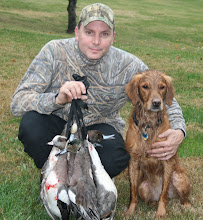
The elusive scotch double - one shot, two birds. And mallards to boot.

My immediate reaction as to apologize to The Hunting Partner for hitting both birds. I felt bad that he didn’t even have the opportunity to shoot. I felt greedy, yet there was obviously nothing I could do to prevent what had occurred. Still, I felt bad. The Hunting Partner is my best friend and one of the most enjoyable experiences is when he and I both drop ducks out of a flock and celebrate our mutual success with laughter and a high-five. This time it was all about me, which was awkward and, as I said, felt a bit greedy.

Max lurched into the water and immediately made his way toward the birds which had already begun to float away in the wind-blown pond. He executed a fine double retrieve, with the second bird being a hefty swim since it had floated quite a distance since he retrieved the first duck and then needed to swim out for the second. His performance added icing to the cake.

The scotch double would be the last group of birds to come our way, so we picked up the decoys and motored back to the marina. A wonderful morning with a very special ending. I just wish everyday could be that great. This is why I hunt, eat, and live!
Thursday, January 1, 2009

Pheasant Risotto with Chantrelle Mushrooms

I know I’ve been very slack on posting recipes and all of my hunting buddies have been letting me know it. They have pleaded with me to post the dishes that I’ve had them over to enjoy the last few months. So here is the first of many to come. And guys, I pledge to try and do better.

I enjoy cooking immensely, but time is usually the enemy for preparing advanced dishes. Plus, to be honest, most of my buddies are not completely comfortable with cooking unless it involves a BBQ. So I’ve committed to them to develop and share recipes that are simple, straight-forward and don’t take a lot of time to prepare. Something they can be successful with first time out of the gate.

This approach recently paid off when one of my hunting partners shared his enthusiasm for having successfully preparing the Seared Duck with Asian Pear Reduction I posted a few months ago for his Thanksgiving appetizer.

This simplified approach to preparing game will hopefully encourage other hunters who have not been comfortable in the kitchen with venturing out a bit. For any of you willing to try, be sure to let me know how it comes out.

This one is a new invention and is wonderful comfort food for the gray, cloudy days of winter. Surprisingly it isn’t a duck recipe (shocking I know), but rather pheasant, which we have several in the freezer from hunts earlier this year. Don’t let the length of this recipe intimidate you, it’s really simple to prepare, just takes a bit longer to write out!

Pheasant Risotto with Chantrelle Mushrooms
Ingredients
2-3 pheasant breasts
4 cups chicken stock (that’s chicken broth guys)
1 1/2 ounces Chantrelle mushrooms wiped clean (If you cannot find Chantrelle, you can substitute cubed porcini, portobello or even regular button mushrooms. Ask the produce person to point you in the right direction).
1/2 – 3/4 cup frozen peas
Olive oil
4 tablespoons butter
1 medium onion, diced
1 clove of garlic, minced
1 1/2 cups Arborio rice (which is just another name for risotto rice)
1/2 cup dry white wine
1/2 cup grated Parmesan (fresh grated, not from that little green can in the refrigerator door guys)
3/4 cup Feta cheese, crumbled
Kosher salt
Freshly ground black pepper

Directions
Prepare Pheasant Breasts:
Rub a small amount of olive oil over both sides of breasts and sprinkle with Kosher salt, fresh ground black pepper, and an all purpose seasoning such as Emeril’s Essence.

Heat 2 tablespoons of butter in a large, heavy saucepan over medium heat, adding the breasts just when they sizzle when entering the pan. Turn down the heat to medium, turning the breasts once after approximately 8-10 minutes, depending on thickness. When the juice from the breasts runs clear, remove from pan and set breasts aside on a small plate.

Prepare Risotto:
In a medium saucepan, bring the 4 cups of chicken stock to a simmer over medium-high heat. Reduce heat to low.

In the same saucepan as you cooked the breasts, melt 2 more tablespoons of butter over medium-high heat. Add onion and cook until translucent and tender, about 3 minutes. Add garlic and cook for 1 minute longer.

Add the rice and stir to coat with the butter mixture. Stir rice constantly and heat for 3 minutes.

Add the white wine and simmer until the wine has almost evaporated, about 3-5 minutes.

On medium-high heat, add 1/2 cup of warmed chicken broth and stir constantly until almost completely absorbed. Repeat, adding 1/2 cup at a time, allowing each addition to be absorbed, until the rice is tender on the outside but still undercooked in the middle. You should have about 1 cup of stock remaining. This should take approximately 15 minutes.

Coarsely chop mushrooms (or cube if not using Chantrelle). Add the mushrooms and peas to the rice, which will balance each other out for moisture. The peas will add water and the mushrooms will absorb it. Cook for a few more minutes until the moisture content settles and the mushrooms begin to soften.

Add the remaining stock, stirring constantly until the rice is tender throughout and the mixture is creamy, approximately another 10 minutes. Keep tasting the rice to find out when it is done.

When done, remove the pan from the heat and cover while you return to the pheasant breasts, cutting each one into approximately 1 inch cubes. Add the pheasant breast to the risotto rice and return to heat to re-warm.

Stir in the Parmesan cheese; salt and pepper to taste. Stir to thoroughly combine all ingredients. Remove from heat and transfer the risotto to a serving bowl. Top with Feta cheese. Serve immediately.

Give this stick-to-your-ribs comfort food recipe a try and let me know how it comes out! Bon Appetite.