Saturday, February 28, 2009

Hunter Education - Is it Sufficient?

Last week I wrote a post about The Boy successfully completing his hunter safety certificate and there were a few comments that invited some interesting discussion. One reader wrote,

…“As a father of two young boys, I, too, look forward to the time when they can get their hunter's safety certificate. However, I do think we have a serious problem with hunter education today. I think it needs to be an ongoing and more rigorous process. Think about it: What does it say about our hunter education system when an 8- or 9-year old child can score 90 percent on a hunter education test? What are they really learning? What will they remember when they're 14 or 18? Think about the message that sends to the nonhunting public when almost any child can earn a hunting certificate before they're done with 4th grade. It's ludicrous"...

That comment invited the following response,

…“The fact that The Boy passed with 90% isn't because the test was easy, it was because he, his father and I took a vested interest in him respecting the reason for the test, the process of studying for the test and taking the test… He passed with 90% because he put hours of his time into it…

There are two ways for the new hunter to learn, those who 1) study the guide and continue to use [it] as a resource and 2) have an incredible mentor to teachthem in the field. Unfortunately, you can't really do #2 without number #1. Forgive me if I'm on a soapbox, but I don't want anyone, for one minute, to think any 9 year old could pass that test with 90%. The Boy EARNED that score."


This healthy exchange got me wondering if there was any data to back up either of these reader’s comments. I’ve heard and read over the years that hunting – compared to other sports – is one of the safest outdoor activities.

And in fact, according to The International Hunter Education Association, 2,369 out of every 100,000 football players were injured or killed in 2001 compared to only six (6) per 100,000 hunters in all of North America. Even swimming (319), golf (173), soccer (1,262), and basketball (2,326) all experienced many more injuries and fatalities than hunting.

According to the National Shooting Sports Foundation, “Firearms-related accidents have declined sharply even as gun ownership in America is rising. More than half of all households now own firearms, yet accidental fatalities are at an all-time low--down 60 percent over the last 20 years.”

So hunting clearly remains a safe sport.

But what about age and hunting accidents? Interestingly national incident reports filed with the International Hunter Education Association show that the average age of the shooter involved in an incident in 2007 was 37.9 years old.

Breaking down the numbers a little further shows that youth aged 13 and younger had 15 incidents, while older hunters (14-68) averaged 34 incidents per ten-year age bracket. Only once you crossed over to seniors older than 70 years did the figure drop to six incidents.

Although we don’t know the age distribution of hunters in US, these stats clearly show that youth is not an outlier in terms of the number of accidents. Even if we assume that the youngest and oldest categories have fewer hunters and adjust the accident rates by percentage accordingly, there is still no significant difference between young, prime, and older age for hunting accidents.

It is also important to remember that not all hunting accidents are due to the shooter’s mistake. Victims moving into the line of fire accounted for 6% of hunting accidents in 2007.

Back to the original reader’s comment for a moment. He believes there should be a “system where hunters have to retake the exam every five years or so -- and the test could get more difficult accordingly to require some ongoing education. The test for adults should be different than the one a 9-year-old can pass. The safety scenarios and exam questions should be more complex and demanding as should questions about wildlife biology, conservation, the philosophy of hunting, heritage, etc.”

In my professional life we deal with licensure for health care professionals and there is a similar debate about whether there should be a requirement for continued competency, which is what this reader is suggesting. The question I have, however, is seeing that hunting is already one of the safest recreational activities and knowing that the data does not show any one age bracket has statistically higher hunting accidents, would continued hunter education testing achieve the goal of safer hunters?

While re-testing hunters every five years as the reader suggests may incrementally improve the number of hunting accidents, I believe that it would have a larger detrimental effect on hunter recruitment. Is this worth a small, if any, reduction in the number of injuries or fatalities? Can we ever expect to totally eliminate the risks associated with hunting?

While I do think that the current hunter education programs need a healthy update (The Boy saw the same videos that I watched in the 70’s), the fundamental curricula appears to be sound. I would hate to sacrifice the involvement of new ranks of hunters for additional safety protocols that would have limited, if any effect.

What do you think about the state of hunter safety and education?

Sunday, February 15, 2009

Adding Hunters to the Ranks

There are a few keystone moments in a kid’s life that he or she can remember in vivid Technicolor. For me, one of those memories was the weekend that my dad took me and my friend to get our hunter safety certificate. I remember the drive out to the Isaac Walton League and entering that cold, brick meeting hall with all the other fathers and sons (unfortunately there were no huntresses or daughters). I can still smell the stale, dank air and how quiet we all were with anxious anticipation.

As a Midwest country boy growing up in the 70’s, achieving your hunter safety certificate was a defining and memorable time in life. That may seem like a bit of an overstatement for people who don’t hunt. But for those of us where hunting was a part of our family legacy, a hunter certificate became a symbol of manhood; a right of passage of sorts.

Now, as a father myself, I have been looking forward to the day when The Boy and Daughter will have the same opportunity to experience that defining moment. The legacy of hunting endures in my family and the values we hold for the outdoors are equally strong.

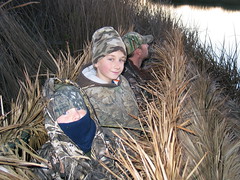
Last Thursday was that day. The Boy, now 9, decided he was ready and has spent the last couple of months studying his hunter safety materials. I was so proud of him for taking his studies serious – reading the handbook; completing online practice tests; successfully passing the online exam; and enduring a 4-hour finishing class on a school night. All of this culminating in a successful in-person exam with a score of 91%!

As we departed the church where the in-person class and exam were held, I’m not sure who was more excited – him or me. It was late, 11:30pm by the time the test was scored and the final paperwork completed. I could sense that he was dead tired, but equally excited. As we strolled toward the car in the quiet, damp night, I put my hand on his shoulder and gave a squeeze of approval. The Boy stopped, looked up at me and said, “Hey dad, thanks for being here with me. I love you.”

Whoa. Who says grown men don’t cry.

The interesting aspect of Thursday’s event is that I had been focusing on it as The Boy’s journey of becoming a hunter. In reflection however, I think the day was equally impactful for me – also a right of passage if you will – as a father. The first child to enter la confraternidad de cazadores – the fellowship of hunters.

Having a young man – and next year a young lady – join the world of hunting is important to me and my family. We are fortunate that our community has several families who also hunt so there is a good deal of shared interest and values. But I am also acutely aware that just a few miles down the freeway is a burgeoning metropolitan area where the notion of guns is viewed in a very different context.

Last week, Kristine at the Outdoor Bloggers Summit offered a new challenge after reading an article in the American Spectator. To save you the pain of reading the entire article, the gist was that the outdoors are reserved for beer-slogging white guys and that women and folks of color should just stay home and do, well, I’m not sure what. If you click to the article, you’ll get a sense of the hunting community’s response in the comments section.

I found a stark irony in this past week’s events with The Boy, this article, and the OBS challenge. I couldn’t help but think that – unfortunately – it may very well be that even us middle-class white guys have failed to do enough to ensure the continuing heritage of hunters.

While the focus of the challenge was to discuss why the outdoors is for everyone, I can’t help but think about several friends I know who grew up in hunting families but who have now immersed themselves in careers and other interests and are not teaching their kids about the outdoors.

How can we expect to have our kids invite their nontraditional friends along if we aren’t introducing them to hunting in the first place? Based on national hunter acquisition statistics, I would go so far as to say that even the ‘traditional hunter’ is quickly becoming an endangered species.

Indeed, the outdoors is for everyone, including middle-of-the-road folks who must continue the traditions in our own families as well bringing people of all backgrounds and genders into the fold. Let’s make sure we start inside our own homes as well as make active strides to invite others to join us. We must have a sense of urgency about this if we are going to have a chance.

Tuesday, February 10, 2009

Emerging from the Funk


OK, I admit it, I’ve been in a funk for the past two weeks. By now you'd think that I would begin to expect it, but just like clockwork, the end of the hunting season sneaks up on me and POW, I immediately fall into a deep funk.

The obvious symptom is that my blog posts came to a screeching halt after my hunting season review post two weeks ago. My gosh, TWO WEEKS! Not good for retaining readership.

Even my Google Reader has been seriously neglected. I checked in today and had 87 posts from friends and fellow bloggers that I had not yet read - let alone left comments. I apologize to all my blogging colleagues for being such a slacker. I promise to do better.

I think the level of my post-season depression is directly correlated with the level of effort I have put into the hunting season. The harder and more frequent I have entered into the outdoors and enjoyed the bounty of my effort; the greater the funk-o-meter gets jacked up after the season. It is a perverse, inverse relationship.

I can’t help it, I just love to hunt. One of my non-hunting friends and I were discussing this curious state and he asked me what it's like to wake up on Monday morning after the season closes. The closest parallel I could think of, as cheesy as it sounds, is the day after Christmas. You would think that after so many years of hunting that I would be have greater mental stability to accept the inevitable situation. But no, it still sucks.

The last few weeks were also very busy with work and a community benefit concert that I was preparing for as the master of ceremonies. The concert was last Saturday and then I immediately got on a plane for 5 days in Washington DC, so this is really the first time that I’ve had to even think about blogging.

So, enough of the funk, it’s time to move on. I have emerged!

Coming up in the next few weeks I am going to turn up the heat in the kitchen and start turning many of those wily game birds into some fantastic new dishes. Although my typed words have been seldom, I have actually been noodling through a couple new dishes in the old noggin.

I’ll also be writing about some interesting observations about hunting and the media as well as a couple stories about The Boy and the upcoming turkey season.

Until then, thanks for tuning in again. Sorry it has been so long. I’d enjoy knowing how you all are up to.