Showing posts with label General Hunting Interest. Show all posts

Thursday, January 14, 2010

Getting Back into The Swing


Oh Lordy, I know, I know. It has been F-O-R-E-V-E-R since I have written a post. I don't know what it is, but it just seemed so hard to make the time to pull everything together over the holidays. Unlike some of my fellow blogger peeps who are either in the outdoor industry and blog for their job or they are making their blog a full-time pursuit, I am just an average Joe working five days a week, 10 hours a day, and have a wife, two kids, two dogs, and a cat.

Over the holidays I was burning the candle at both ends and by the time I would sit down at night to begin writing, I would suddenly find myself sound asleep on the couch only to be awaken by the cat climbing on my head. Go to bed, wake up, repeat.

When I am not working I'm being a husband and dad, ensuring that I am checking homework and rooting on The Daughter's dance or The Boy's soccer and basketball.

On the weekends I am totally committed to going out with The Hunting Partner chasing those wonderful feathered fowl, which have been a little harder to come by this year, but we're still at it every weekend day. The season has been generally slow, but things are picking up and The Hunting Partner and I hunted a new place last weekend and pulled out the first limits of the season. Hope runs eternal! More about that later.

Oh, and my wife and I also hosted a couple of wild game dinner parties, including a five-course duck and pheasant dinner on New Years Eve for 14 people. I promise to write about that one. Let me just say - FABULOUS!

Don't get me wrong, I am not complaining at all and feel so blessed to have a fantastic life. Its just that I want to be able to do more blogging because I really enjoy it! I feel bad because I get emails from you, my readers, checking in on me and hoping that everything is OK. I appreciate all those warm thoughts and feel guilty that you are looking for me but I've been absent.

The New Year is for promises and resolutions. I've been reflective and made my list and I promise it does include getting back into the swing of things with regular posts.

Thanks for hanging in there with me and look for more... soon.

Sunday, November 29, 2009

A Fowl Feast

For those of you who’ve been following this blog for a while will remember that late November is my birthday. Some years it lands on Thanksgiving Day, but it usually brackets the holiday by a day or two. My family claim to fame is that my parents brought me home from the hospital on Thanksgiving Day, and I always would remind them that they had much to be thankful for that year. My four older siblings would beg to differ.

Last year I turned the big 4-0 and wrote this post about the incredible birthday present that my dear wife gave me. Since this year would be the much less climactic 41, I was prepared to just ease into and out of the day without much fanfare. The last 10 weeks at work have been very busy, so honestly I was looking forward to just downshifting and taking it easy.

But my wife, being the amazing, wonderful person she is, had other plans. A month ago she had attended a client function and met Jeffery Pooler, the owner of Pearl on the River, a new localrestaurant in Sacramento. They got to chatting and my wife learned that Jeff had opened Pearl earlier this year and was really making his culinary footprint on the city. According to Jeff, Pearl on the River is committed to featuring the freshest, most flavorful dishes from local farms. Their ‘live menu’ means that the menu may change daily to accent the best of the local region.

Pearl’s other specialty is that their executive chef, Matthew Jones, loves to work with wild game! After learning this little gem, my wife decided that an evening at Pearl on the River with 16 close friends and fellow hunters would be the perfect birthday present.

We decided that we would bring Chef Matthew a trio of fowl including ducks, geese, and pheasants to work his magic. The mallards and pintails as well as Canada geese and specks were some of those we had harvested a couple months ago in Saskatchewan, which I wrote about here. We had fewer pheasants than I would have liked because the season was barely two weeks old. But they were whole birds so I hoped Chef would have enough to do something interesting.

I have to admit, I was a little nervous because I knew nothing about Pearl or Chef Matthew. There are a couple of other nice restaurants in Sacramento that have become known for their wild game feasts, but because my wife had met Jeff and arranged everything (including dropping off the meat), I just quietly hoped that these guys knew how to prepare wild game – which is very different from domestic, farm-raised meats.

***

Arriving at Pearl we learned that the restaurant had reserved the upstairs kitchen for our group, which can seat about 25 guests around a horseshoe-shaped open kitchen where Chef Matthew, his sous chefs and assistants cook, entertain, and talk with their guests all evening. They thought of everything to give their guests an interactive experience, including mounted cameras inside the kitchen that had a live feed to flat screens on the walls so you could get a birds-eye view of the chefs at work.

As Chef Matthew began plating the first course in front of us, I drew hopeful that the dish was going to taste as good as it looked. And did it ever! The evening would provide seven courses overall, and started with an amazing paired appetizer of goose breast pate’ on crostini with applewood smoked bacon and lemon dressed micro arugula, and duck breast pate’ on crostini with truffle oil and micro arugula.

The subtle smoky flavor of the bacon with the pate’ was a tremendous combination!

The second dish was comprised of duck confit won tons with an asian-style cranberry dipping sauce. The richness of the duck with the spark of the dipping sauce was the perfect combination of strong and sharp flavors put together in one amazing dish.

The evening was off to an incredible start, and any anxiety I had about this chef’s ability to create spectacular food with wild game were quickly vanished.

Next was a very interesting dish - duck confit ravioli with rich duck stock and parmesan cheese. The duck stock made this dish. It was a very light broth that really allowed the flavor of the ravioli to shine.

At this point we moved from the starter wine into the main red with an amazing bottle of Roth Estate cabernet. I really love Roth Estate wine. My wife bought a bottle a year or so ago simply because she thought it was cool that there was a wine with our last name. Turned out that Roth winery is a small family owned vintner located about 50 miles of my house in the heart of the world famous Napa Valley. The cab is deep and oaky with just the right richness for the next dish, which was grilled rare duck breast marinated in orange juice with spicy orange glaze and potato parsnip puree. Although it doesn’t sound like the wine would go with this dish, it actually paired very well. The orange flavor was very ‘behind-the-scenes’, which didn’t conflict with the wine in the least bit.

On to dish number five! Frisse and spinach salad with blue cheese, apples, roasted goose breast tossed with sherry vinaigrette accompanied with a fried duck leg. Of the seven courses, this was my third favorite dish of the night. I am a sucker for blue cheese and apples in spinach salad so you throw on some goose breast and it’s near perfection. The little duck leg on the side might as well been just for looks, but I appreciated that Chef Matthew tried using every part of the game we had given him.

Next was a dish that I felt was the best dish of the evening. Roasted pheasant with baby green beans, butternut squash bread pudding and cranberry sauce. OMG! This was a like our own little sneak peak of Thanksgiving dinner, but kicked up about ten thousand notches. The pheasant was pulled (think pulled pork) and accompanied the butternut squash bread pudding perfectly! Get that combination on your fork, add a touch of cranberry sauce and this one really knocked it out of the ballpark.

At this point all of our guests were buzzing with how wonderful each new dish had been better than the last one. But honestly we were starting to run out of room to taste much more. Even though each of the dishes had been small, six plates equal a lot of food. So when Chef Matthew announced that we would be moving on to dessert, we were glad to know that we would be rounding out this incredible meal with a palate-cleansing finishing dish.

What we didn’t expect was that Chef Matthew had one more trick up his sleeve – house made chocolate dipped duck confit vanilla ice cream. What’s that you say, ‘chocolate dipped duck confit’ in vanilla ice cream. Why yes, that is what I said! This one you will just have to take my word, it was incredible! It was the perfect combination of sweet vanilla with a touch of chocolate saltiness in between when you found a small piece of duck confit. It was the most interesting and one of the most fun desserts I’ve ever experienced. If the pheasant wasn’t so amazing, this would have been my favorite dish of the night.

Between all of the incredible food were a lot of laughs, good fellowship, and a good-natured ribbing from seasons gone-by. I would like to thank owner Jeffery Pooler, executive Chef Matthew Jones, the sous chefs and helpers for putting on an incredible event. If you are ever in Sacramento and want a fantastic wild game meal, look up Pearl on the River for a truly amazing experience. From the live cooking in front of your group, to the bantering with the guests, it was a wonderful night that accentuated how great it is to hunt, eat, and live.

Thursday, October 29, 2009

A Boys First Duck Hunt

Reports from opening weekend of the California waterfowl season were about as exciting as a Twitter feed from the Pope. Most accounts from friends and fellow hunters reported slow shooting action on this most anticipated weekend of the year. Most reported a smattering of local birds being harvested, but with sunny days and warm temperatures upward of 80 degrees, the birds were fat and happy loafing in their favorite watering hole. Fellow blogger Holly and her boyfriend had about the best report I had read after a nice afternoon at Delevan National Wildlife Refuge. Other than that, all was quiet on the western front.

I don’t know what it is about this year, but maybe there is something to this whole global warming thing. You’ll recall we experienced similarly warm weather while waterfowling in Canada last month. Now this? Go figure.

The poor report didn’t completely matter however because, as it turns out I had to work on opening weekend. Damn strategic planning meetings anyway. I hated the thought of my buddies out in the marsh taking spectacular shots at ducks on the wing and finishing with limits of fowl in two hours during a glorious morning. All the while I am listening to a “facilitator” drone on about being a 21st century company. Ugggg. My sweet revenge was that the opener stunk. Neeener neeener.

By Wednesday I was chomping at the bit to get out and sit my butt in some swamp water in an attempt to harvest the first birds of the season. Luckily I had sent in reservation applications for both myself and The Boy at several of the California public refuges and had drawn a reservation for Wednesday morning.

The California refuge reservation system is a fairly competitive process wherein hunters from around the state pay $1.25 per application entry, per hunt day, for each refuge that they want to hunt. Thousands upon thousands of applications are turned in each year for a coveted refuge reservation card to show up in the mail. The odds at some of the best refuges can be upwards of a 60:1 chance of getting drawn. Other less productive refuges range from 10 to 20:1 odds.

I was excited to receive a reservation card for Wednesday in that it would only be the third shoot day of the season (refuges only shoot on Saturday, Sunday, and Wednesday) so there would be a good chance that many of those local birds that didn’t move around and get shot over the weekend would be susceptible on Wednesday morning.

The more pressing reason for my excitement was that I planned to take The Boy for his first-ever duck hunt. To me this was the culmination of all the hunting that I had imprinted on him as a youngster. It was his very own opportunity to harvest his first meal.

Our reservation was for the Yolo Wildlife Area, a relatively new refuge that is literally 15 minutes from downtown Sacramento. The refuge manager has been working hard over the last 10 years to improve the habitat and provide a quality hunting program. Part of these enhancements included the installation of island blinds several years ago.

With reservation #6 I knew that The Boy and I would have a chance at a good blind. Having done my research and talked to a few people who hunt the area often, I knew which blinds generally produce better and which produce worse.

***

The alarm clock sounded at a much-too-early 3am and after getting to my feet, I padded my way down to The Boys room where he woke without much resistance. We pulled our things together and made the one hour drive to the wildlife area check station where we waited for the check station staff to begin calling the reservation numbers.

When our number was called we selected the best blind available then made the one mile journey on foot to the small posted sign that signified where we were to enter the pond. After transferring all of our gear from the decoy cart to our backs, we slogged our way across a 200 yard section of pond to the island that housed our concrete pit blind.

As the boy fixated on stomping out the 500 crickets that had found comfort in our blind overnight, I went to work on setting out the decoys in a string that would position any decoying ducks right in front of The Boy’s side of the blind. Today was all about him.

Unlike opening weekend, a mid-week cold front had swept in from the north and a wonderful 15mph wind blew constantly across our cheeks. The temperature was a brisk 43 degrees without considering the wind chill. Not exactly frigid, but certainly cold enough to keep the birds moving around.

As shooting time drew near, I took extra care to pause and enjoy every minute that The Boy and I shared together in that blind. As a father, I knew that there is only one ‘first’ and I wanted to make sure that I made the most of it for both of us. It wasn’t about how many birds we would shoot or whether we got our limits, it was all about being in the moment. One of those keystone events that is etched into both of your memories for a lifetime. I wanted to get this just right. You only get this opportunity once, so I wanted to make the most of it.

With five minutes remaining until the opening bell, I shook my son’s hand, we wished each other luck, and loaded our shotguns.

Boom, boom went the first report of the morning several fields across the way. “Game on”, I thought.

For the next several minutes we witnessed flocks of birds moving head-strong into the wind; a bunch of teal here, a half dozen mallards there, and a flight of specklebelly geese fighting to make horizontal progress. Several more guns reported in the early morning air, but I could tell that the birds were not looking like they were in a decoying mood. Although it was cold and windy, the sky was crystal clear so most of the flocks we saw were ‘on a mission to somewhere’, as we like to say. Meaning that they lift off from where they were roosting and immediately head up to about 100+ yards and head out of the refuge, ignoring calls and decoy spreads all around.

It was exciting to see all of the birds flitting about. I pointed out the different groups to The Boy and did my very best to try and call lower groups into our blocks; but nothing wanted to work into the decoys.

Finally, after 20 minutes I notice a pair of teal low on the water heading squarely our direction at roughly 150 yards. I whispered to The Boy that there were two coming in, and after pointing out their direction, he indicated that he had the visual on them as well.

This was it, these birds were coming in and I knew The Boy was going to have his first chance. The birds were continuing to come straight toward us when I noticed that the lead bird started to slip to our left, which was a good sign since The Boy was on the left side of the blind. If I’ve seen it once I’ve seen it a thousand times, I knew that this pair was going to slide out to the left and bank around the blind. Ducks don’t like to fly over land masses so they were either going right or left. The lead birds’ twitch to the left had me whispering under my breath, “This is going to happen.”

With the aerodynamics in the bird’s favor, these ducks were coming in fast. So at 30 yards I told The Boy to stand up and get his gun ready. By the time he was set, they had closed the gap to 15 yards and, as predicted, were skirting the left edge of the blind. I hollered, “shoot ‘em”, and in what seemed like an eternity later, I finally heard POW.

I saw the lead teal crumble and splash to the water below. We both squealed like a couple of school girls and my first reaction was to state what was now clearly obvious, “You got it son, you stoned that duck!” Woo hoo!

He and I leapt out of the blind and I gave him a great big bear hug. I grabbed his hand and we walked out into the pond where I picked up the lifeless bird and handed it to him.

He paused for a minute admiring his harvest, then muttered, “I did it, I got one.” You sure did son, you certainly did.

With ducks still filling the air we gathered our senses and made our way back into the blind. Unfortunately no other ducks wanted to work, which was fine because it gave us time to talk about the events that had unfolded earlier; embellishing on the spectacular nature of it over and over again.

After two hours of little activity we agreed that we would pick up and head back to the truck in 30 minutes. Just as I finished uttering those words, a duck flew in from the north but landed far outside the decoys, about 80 yards from our location. I told The Boy to keep an eye on that bird just in case it got up and came our way.

Sure enough, ten minutes later hunters in one of the other blinds blasted away at a duck and the noise rousted the duck near us from her loafing spot. Because she was to the north I knew there was a chance that she would get up and make a turn to begin heading south with the wind. Almost on cue she did just that and as she gained altitude she banked left and was heading right toward us!

I told The Boy to get ready, but this duck was beginning to catch some serious tail wind. She was also swinging to the right side of our setup meaning that she would cross on my side of the blind. I told The Boy that after she crossed over the top and got out in front that I wanted him to shoot her while I stayed seated.

Just as I instructed, the bird cleared over the top of us and as I sat facing him, he rose from his seat and took aim. I was less confident about him hitting this duck because of the difficult shot. She was gaining both altitude and speed as she bank around our position. A difficult shot for even the most seasoned waterfowler.

I watched the boy take aim and heard the gun report. I immediately looked over my right shoulder just in time to see this duck crumble and fall like a stone into the pond below. Holy cow, he did it again!

This time it was his turn to state the obvious and after checking his safety, he set down his gun and we both jumped from the blind once again. We waded out to see the lifeless bird floating just beyond some tule reeds. This time I stopped a few steps short and encouraged him to go and pick up his quarry, which he did with a youthful exuberance.

To say I was proud of my boy is an understatement. I was not only happy for his success, but also for how he had carried himself the entire day; from getting up at 3am, to making the one mile walk, to sitting in a blind without any action for two hours. All without even the hint of a 9-year old complaint or gripe.

We decided to end the day on that high note and began packing up our things. As we picked up the decoys we recounted all of the days’ events as if they were tales from long ago. After walking the mile back to our truck, we checked in his birds with the check station staff and began the drive home.

As The Boy settled into his seat and I steered the truck onto the freeway, the late morning sun filled his passenger window. The warmth of the sun was a nice break from the constant morning wind, and before long, The Boy nestled down for a much-deserved nap. As his eyes grew heavy he turned his head and caught my attention with that youthful innocence that I love so much. I glanced his way and he simply said, “Thank you dad. I love you.”

This is why I live to hunt.

Wednesday, September 30, 2009

Duck & Goose Hunting - Canada Style!

Last week marked the return of a pilgrimage that had been on hiatus for the past couple of years. It was the return to a remarkable land, full of wonderful people and an amazing bounty of wildlife. We began this annual migration in 2004 when I decided to put together the ‘hunt of a lifetime’ for my father, brother and good friend of mine.

The kind of hunt that you save for all year and only plan to do once. That was five years and three trips ago and we were back at it again this year.

Along with the original four, this year we invited two additional fellas to experience this journey to the north – my hunting partner and my good friend’s 12-year-old son. We had been absent from this Canadian adventure for a few years because of my mother’s illness, which kept dad close to home. So to say that we were anxious and excited to return to these northern roots with new friends in tow, is an understatement.

Four of us would fly from California, the other two drive from Colorado, with the predetermined rendezvous spot in Saskatoon, Saskatchewan. There, like the years before, we would join together and drive the rest of the way to the small, rural town of Radisson where our friend, Jim, from Wild Goose Outfitters would await our arrival.

***

The flight from Sacramento was early, which meant leaving the house at 4am to ensure we arrived in plenty of time to check our baggage. The early morning didn’t bother us as we were like kids at Christmas waiting to open our presents. With no traffic we made quick time to the airport, which allowed ample time to go through the additional layers of paperwork required to bring along our shooting sticks. It’s a fairly straightforward process for US residents to take firearms into Canada, so long as you’ve done your homework in advance and allow for a little additional time at the airline check-in.

Little did we know that, with the bags safely in the hands of the airline, the first excitement of the trip would occur at the airport itself. My hunting partner and I navigated the TSA security screening gauntlet just fine and waited at the exit for my friend and his 12-year-old son. As we watched his son’s bags move along the x-ray belt, we suddenly noted that there was a bit of a stir with the TSA agents who all began pointing at the x-ray screen and whispering amongst one another. Suddenly, one of the agents grabbed the son’s bag and instructed him and his father to go to the TSA security desk. The screener handed the son’s bag to the agent behind the desk and said, “We have a live round in here”.

My friend shot a look at his son that would have pierced steel, and asked his son, “You checked your bag for shells, right?” His son sheepishly nodded in the affirmative, at about the same time as the TSA agent pulled a 20-gauge shotgun shell from the front pocket of the son’s bag.

My friend’s face turned from, ‘I could kill you kid’ to ‘oh crap, we’re going to jail’ in about two nanoseconds. My friend inquired with the TSA agent as to what was going to happen, but the stone-faced agent promptly ignored him and made six, yes SIX, calls from the ‘red telephone’ making the same somber statement each time– “We have a live round.” My friend asked again what might happen and the agent responded tersely, “I’ll tell you when the sheriff arrives.” – Gulp.

My hunting partner and I hovered anxiously just outside the screening area and shortly thereafter a sheriff’s deputy arrived. The deputy pulled out an evidence bag and asked my friend’s son a few questions about how the shell ended up in his carryon bag going through airport security on an international flight (that just doesn’t sound good, does it). Seeing that the 12-year old didn’t appear to have any terrorist tendencies, he said, “Don’t worry son, it’s Fall and this happens all the time. Besides I don’t have any handcuffs that will fit you. Go ahead and take off.” Whewwww. I’m not sure, but I think the boy pee’d a little in his pants. From that point forward my friend’s son inherited the nickname ‘Shotgun’. [In the interest of a great blog story I almost asked the sheriff for a picture with him and the kid holding the shotgun shell – but I resisted not wanting to push our good fortune!]

So, 30 minutes into our trip we hadn’t even made it to the gate and we already had quite the adventure.

The flight to Denver was uneventful and we arrived in time to grab a little breakfast before catching the second leg of the flight to Saskatoon. Little did we know that our little morning law enforcement run-in would not be our last hiccup.

We boarded our little missile-with-wings regional jet and sat growing more excited at being one step closer to the waterfowl holy land. At the scheduled departure time the captain announced that we would be pushing back shortly as soon as the ground grew finished loading the remaining bags. We peered out the window of the airplane to survey the scene just in time to see the two ground crew agents picking up and tossing, yes tossing, all of the gun cases (of which there were about 15 or so) into a neat little row onto the tarmac next to the plane. We bitched to each other about how disrespectful these ding-dongs were and wondered if they even had a clue that they were tossing cases containing $1500 dollar shotguns around like some old lady’s overnight bag. We concluded that these thugs weren’t paid enough to care. All I will say about the airline is that we were United in our contempt for these idiots.

To our shock, a mere minutes later the plane jolted backwards and we were being pushed back from the gate. Problem was that the gun cases were still sitting on the tarmac. This can’t be good.

We rolled our eyes and immediately started buzzing with the other hunters on the plane about what the Canadian customs and border agents were going to think about these camo-clad foreigners - who they were expecting to show up with registered firearms - instead showing up with papers and nothing else. Conversely, we wondered what the U.S. TSA would think about a bunch of Americans who had checked firearms on an international flight and were being sent along their merry way sans guns. What floored us most is the consideration that we couldn’t take a 3.5 ounce bottle of shaving gel through the security checkpoint, but the airline can separate 15 guys from their firearms on an international flight and leave those guns sitting on the tarmac of Denver International Airport. This was going to be interesting.

***

Sure enough, as we land in Saskatoon and filter our way down to customs and immigration, the first few guys relay our collective story to the Canadian border protection agents. The agents rolled their eyes in familiarity. Clearly this was not the first time they had encountered this problem.

Over to the airline counter for two rounds of ‘lost baggage’ forms (which I don’t understand, we knew exactly where our gun cases were – sitting on the tarmac at DIA!), and then over to pay for the Canadian firearms entry fee, for which we of course had no firearms to produce. Next to customs where another form is completed and gun serial numbers documented with instructions that the airline will deliver the guns to the hotel where we were staying as soon as they arrived on the next flight… if they arrive on the next flight.

WHAT! You mean there was no guarantee the guns would be here on the next (and last ) flight of the night? That’s right, no promises. I thought to myself, ‘Well even if they do show up what are the chances they will actually deliver them to the hotel. Not.’

Needless to say, we go to the hotel, eat dinner, have a cocktail then head back to the airport to survey the scene at the time the second flight is scheduled to arrive. Standing outside the baggage claim area, we wait and wait, peering our noses through the frosted glass doors to see if we can get one of the border agents to tell us what is happening. Twenty minutes later someone finally comes out, escorts us into the customs baggage claim area and tells us to go get our cases off the baggage carousel. Luckily, all our cases arrived and after another form and quick ID check, they let us leave with shotguns in hand.

Finally, everything was coming together.

***

Jim Bartrop and Kevin Wright, owners of Wild Goose Outfitters, are the kind of guys you just want to have a beer with the first time you meet them. They are completely focused on making sure you are comfortable, well fed, having a good time, and ultimately get you on the birds. The guide assigned to us, Dave, is the same one we’ve requested each year and is one of the best waterfowl hunters I know. He treats you more like a friend than a client while in the field.

I’ve been on some crappy guided hunts with local guys who treat you like an idiot and are clearly doing the minimum to get through your hunt. The fellas at Wild Goose Outfitters are just the opposite, they are never satisfied and work hard for you every day. We also enjoy the way they run their outfit, only inviting repeat groups that they know and trust aren’t going to bring drunken idiots into camp. They run a professional, low-key operation, just like we like it. (Disclaimer: I received nothing for this reference, Jim doesn’t even know I’m writing this yet).

We planned to hunt our standard three-day package targeting waterfowl exclusively. You can only hunt geese until noon in Saskatchewan this time of year, so the hunting setup entails geese at sunrise and ducks at sunset.

Arriving in camp, we found Jim to be anxious and aggravated. After a brief discussion we learned that he was concerned about the very warm weather they had been experiencing, which was keeping all the geese far north and no ducks to speak of yet. We assured Jim that we were going to have a great trip anyway, but it is his nature to be uptight – even with Mother Nature – to satisfy his guests.

Indeed the weather was in the upper 70’s when we arrived on Sunday, a good 15 degrees above normal for this time of year. Unfortunately, the forecast was not promising with a steady rise in temperature predicted during our hunting days of Monday-Wednesday. As it turns out, by mid-week the temperature would soar to 94 degrees, a record broken dating back to 1917.

Hunting in the hot weather definitely provided its challenges. Having watched the extended forecast, we were prepared for warm weather, but not 94 degrees so we were baking in our long sleeve T-shirts and waterfowl jackets! Without a frost, the mosquitoes, better known as giant pterodactyls, were thick and hungry warranting repeated bathing in DEET repellant.

Thanks to Jim and his relentless scouting to find the birds, we were put on successful land near water that held some local fowl. It was up to us to make the most of each flight that set its mark for the decoys knowing that we may not have many chances. The birds were skittish and didn’t work into the decoys as usual (probably because the sweat was in their eyes). But those flocks that did work felt the steel wrath from our six barrels pointed in their direction. We took our shooting task a bit more serious this year, which paid off with some great marksmanship. We had many doubles and triples to celebrate after each volley. Of course we had a few ‘how did I miss that one!’ moments as well, which were quickly and painfully recounted back at camp during dinner.

***

The bag of geese was predictably mixed, with lesser and greater Canadas, cackling, Aleutian, snows, ross, specks, and a few blue-phase snows thrown in for color. The ducks were exclusively mallard with only a dozen pintails to show for the entire trip. We were fortunate to have harvested a good number of drakes in the duck flocks, although it is impossible to target them this early in the season. Everything has a brown head, brown body and orange or grey feet. Once in a while you’ll see a little color but mostly it is picking the bird you can make a good, clean kill shot on and taking that shot. Unlike the US, the Canadian system does not restrict the take of hens or species except for pintail.

In the end we harvested 143 waterfowl over three days, which averages out to eight birds per person per day. That may sound like a pile of birds (which it is), but surprisingly it is below average for what we’ve experienced in Canada in previous years. Typically there are more birds than you can effectively focus on. The kind of swarms that allow guys to make the kinds of videos that Holly hates. But its not about the numbers, it was about a fun, relaxing, safe trip with family and friends. We are thankful for the bounty; had a heck-of-a-lot of fun doing it, and managed to bring back meat for our freezers. That is why we live to hunt!

Tuesday, September 8, 2009

The First of Many Hunts

The dawning of September 1st is always an exciting time of year for hunters. It signals the changing of seasons – literally and figuratively – as we anxiously anticipate the first bird hunting opportunity of the year. Most states throughout the U.S. have a dove hunting season and those seasons traditionally begin on September 1st. The Fish & Wildlife Service says that doves are most-harvested of all game animals in the U.S., a testament to the ceremonial beginning of the hunting season.

Dove hunting camps are legendary with stories of large groups of hunters gathering for early mornings filled with fast and furious wing shooting and afternoons full of food, family, and fun. Those tales are typically associated with large plantations in the south, but around here we have a similar annual tradition that has become quite special. I wrote about it here.

But this year was gearing up to be even more special because it would be The Boy’s opportunity to participate in his first real hunt. I’ve written previously about The Boy’s journey in obtaining his hunter safety certificate and all the practice time we have spent at the Sporting Clay course, but this would be the real deal – his first game hunt.

For a dad, this opportunity was equally special. In fact, I’m not sure who was more excited, me or The Boy, about the prospect of heading out for his first hunting weekend at the invitation of Dave, my good friend. Dave is a third-generation land owner of 450 acres of beautiful oak-studded foothills in northern California. He has created an amazing place where the guys retreat a few times of year for the opening of dove and quail season.

This year The Boy would carry his firearm, with starry eyes filled with the hope of harvesting his first game. Since September 1st was in the middle of the week, we had the advantage of receiving early reports from others who were able to ditch work and head out for the opener. Unfortunately, the early reports were spotty, with some early-season cool weather likely pushing these migratory birds toward the heat of Las Vegas or Mexico.

Keeping the sultry 100 degree northern California heat is critical for good dove hunting, which isn’t normally a problem for us through mid-September. But it seems that every few years we get a freak cool spell around the end of August that sends a memo to the doves that its time to pack your bags and head for the desert.

Arriving in camp Friday evening confirmed the early reports we’d received. At 5:30pm it was only 85 degrees, which is a good 15 degrees below what we’d hoped for. Driving into the property didn’t reveal the usual groups of doves bouncing between the fields, just a couple of mockingbirds and a grey squirrel, an early indication of what was in store for us over the weekend.

After exchanging greetings, we headed out on the ATVs into the upper meadow where, if the doves were around, we were sure to find them. As The Boy and I set up our stools and loaded our guns, a gun reported from the opposite end of the meadow from one of our camp-mates. Good news!

As daylight began to fade into the last 30 minutes of shoot time, our hopes increased for a final flurry of grey ghosts to pile into the field for their supper. Unfortunately, the dinner bell never rang and there were just a couple of birds that skirted the end of the field, too far out of reach.

As we arrived back in camp, the evening began filling with stories, laughter and plenty of food and wine. The perfect end to our first day at dove camp.

We accidentally overslept by an hour the next morning (darn kids – we counted on them to wake us up!), which I believe has a direct correlation to the amount of wine consumed the night prior. After a quick guzzle of roughneck coffee, we were blazing down the dusty road back to the upper meadow where we knew any doves in the area would be using this corridor as their personal super highway between the roost and breakfast in the meadow. We set up and waited for the birds to arrive, but unfortunately, like the evening before, they were nowhere to be found. It was official, the birds had boogied south at some point in the previous weeks. The few local resident birds that flittered about were too wise to fall for our usual tricks and always kept a towering oak tree between us and them.

As you can imagine, with this being his first trip, The Boy was a classic example of the first phase of a new hunter – “I just want to shoot something!” Knowing he would be getting anxious, and that the action was not likely to turn to hot-barrel shooting this trip, I turned my attention to talking with him about all the other reasons we hunt. We talked about all the fun he had driving the ATV, hanging out with dad and the other fellas in camp, and the beautiful place that we were experiencing. He still begged the hunting Gods to send hoards of doves, but I was pretty impressed that he seemed to ‘get it’, that there were many other benefits to doing what we were doing other than pulling the trigger. I think The Boy put it best when I asked him if he was having fun. He said, “I am having a great time, I’m just disappointed there aren’t any birds.” For a nine-year-old on his first hunting trip, I think that is a pretty amazing perspective.

The rest of the weekend we spent time running the ATVs, inspecting Dave’s newly-built ponds, and helping do some repairs around camp. Oh, and also eating way too much. Unfortunately there weren’t any doves to be harvested, but we all had a wonderful, relaxing time in fellowship together. In the end I think this trip will serve as a great introduction for The Boy as the best lessons in why we live to hunt!

Thursday, August 20, 2009

Kudos to the California Fish & Game Commission

Last year I wrote this post about how hunting regulations had become too complex and confusing. My point was that complex regulations don’t serve the purpose for which they are written – that is to protect from damaging wildlife population levels. But overly complicated regs can easily lead to accidental harvest and, as we’ve been told for years from the biologists, harvest is compensatory to impacting wildlife populations, not additive. My example for this increased complexity was a comparison of waterfowl regulations between 1957 and 2008.

Well, I don’t know whether this simple little blog had anything to do with it, but the California Fish and Game Commission deserves much credit for taking steps this year to simplify the waterfowl regulations. At least a little bit.

***

Knowing that the Fish and Game folks would be setting this years’ waterfowl season and bag limits in early August, a few weeks ago I set out to look up the recommendations coming from the Pacific Flyway Council to the Fish and Game Commission as a preview of what the Commission may likely approve as the regulatory framework for this year. Clear as mud?

As I reviewed the agenda and proposed regulations of the Fish and Game Commission for the August meeting, I was pleasantly surprised to see examples such as the following:

“The existing regulations allow a white-fronted goose daily bag limit of 4 per day… The proposed change would increase the daily bag limit to 6 geese per day… The white-fronted goose population is currently about 600,000 birds and above the population goal of 300,000 birds established in the Flyway Management Plan. The increase in the white-fronted goose daily bag limit is intended to… simplify regulations.

Currently, goose bag limits… allow up to 6 Small Canada geese, 4 Large Canada geese and 4 white-fronted geese. [T]his proposed change would allow a simple regulation of 6 dark geese per day in these two zones.

The existing regulation permits white-fronted goose hunting… to begin on the last Saturday in October whereas the general goose season normally opens on the third Saturday in October. The proposed change would allow hunting of white-fronted geese to begin earlier than the current regulation and would be consistent with the opening date for geese in the Balance of State Zone.

This was just one of several references to the Commission’s attempts at simplifying regulations. Kudos to the Commission for developing a framework that is both based on the evidence of population levels and simplifies the regs for hunters. We will appreciate these changes in the coming months as we enter the field chasing ducks, geese, or other favorite quarry.

Tuesday, April 21, 2009

Someone You Know…

If it hasn’t done so already, breast cancer will touch you or someone you know. This was the case in my own life when, seven years ago, my 30-year old wife and I sat in a dimly-lit radiologist’s office with x-ray films illuminated in front of us when we heard those dreaded words. “This is bad, this is really bad.”

Little did we know it, but that moment in time would be the beginning of a journey. A journey that, if someone had described in words, we wouldn’t have believed it.

When my wife was diagnosed, we had only been married five years. We had a two year old son (The Boy you’ve read about) and a six month old daughter (the fish kisser). We were living the perfect life – a wonderful marriage, two incredible babies, a little suburban home - the life fairy tales are written about.

When the oncologist confirmed the diagnosis we both felt like we had been sucker-punched in the gut. That day started a new chapter in our lives, one filled with the expected fears, sorrow, and pain that accompanies such a devastating illness.

I often say that our “faith and family” are what helped us get through those dark days. After dealing with the shock and immediacy of situation, my wife and I made a distinct decision one day. And that decision was that we were going to live with cancer, despite how things may ultimately end up. We had very young family and it would not be fair to let the disease rule our lives while we were engaged on the battlefield of cancer. We chose to live.

And live we did. I am so proud of my courageous wife, for all she endured and the spirit in which she persevered. Seven years later I beam when I tell people that she is living cancer-free and considered to be cured.

If you’ve read this far, I appreciate your indulgence and promise this really does have something to do with the outdoors!

Last week one of my favorite hunting magazines arrived in the mail and as soon as I got in the house I plopped down on the couch and began thumbing the pages like an excited school girl looking through her first Teen magazine. I LOVE it when my hunting and outdoor magazines arrive. They sustain me during the Spring and Summer months when the only thing I’m shooting are clay pigeons at the local Sporting Clays course.

As I turned the pages I came across an article talking about the explosion of pink-colored gear targeted at women in the outdoors. There were accompanying pictures of some very colorful outdoor products – everything from guns to arrows to binoculars and the like.

The fascination with pink products is relatively new, but there has been several writings written over the past year about them and whether outdoorswomen find them attractive or offensive. Some of my favorite blog peeps, like Deer Passion and NorCal Cazadora, have written on the subject.

But what struck home about the story in the magazine wasn’t the pink products – which I honestly don’t get; do woman really look at this stuff and say, “Ohhhh, piiiiinnnnkkkk, must have!”, and buy it knowing that it is pretty much impractical to use in the field. But I digress, that’s another post.

What struck home about the article was the description of a pink product that I can get behind; pink arrows from Victory Archery of San Diego. The reason I was drawn to it was that Victory has a campaign called the Pink Arrow Project. The company makes and sells their VForce arrows in pink, with the majority of the profits going to the National Breast Cancer Foundation. Now that is just too cool.

I contacted Bart Lawhorn, Victory’s general manager, and asked him how and why they started the Pink Arrow Project. Bart said the idea came about in 2007 at an International Bowhunting Organization National Triple Crown in Erie, PA where for the first time, his wife of 27 years came to help set up the Victory product booth. Bart had made several pink arrows for a young girl that is on Victory’s National Shooting Staff and when Christa saw the arrows, the idea sprung to mind. As a nurse, Christa has been around cancer patients her whole career so the idea was natural.

When several people came by the Victory booth and asked how they could purchase the pink arrows, Christa quickly orchestrated that they would offer them for sale in October, since October is breast cancer awareness month.

Bart says that he receives hundreds of calls and emails about the project, which now donates a large portion of Victory’s profits to this project. Bart says that anybody can help, even if you don’t shoot a bow.

In fact, yours truly doesn’t archery hunt, but I’d buy a few pink arrows from Victory just to support the cause. I admire any company like Victory for their commitment to making a difference. With funding from efforts like this we have made great strides at increasing the cure rates for breast cancer.

If you know someone struggling with breast cancer or simply want to be part of the cure, there are wonderful resources through organizations like the American Cancer Society, and Susan G. Komen For the Cure. Or, simply buy a pink arrow from Victory and slip it in your quiver or put it on you shelf to show your support.

My wife and children personally thank you.

Saturday, February 28, 2009

Hunter Education - Is it Sufficient?

Last week I wrote a post about The Boy successfully completing his hunter safety certificate and there were a few comments that invited some interesting discussion. One reader wrote,

…“As a father of two young boys, I, too, look forward to the time when they can get their hunter's safety certificate. However, I do think we have a serious problem with hunter education today. I think it needs to be an ongoing and more rigorous process. Think about it: What does it say about our hunter education system when an 8- or 9-year old child can score 90 percent on a hunter education test? What are they really learning? What will they remember when they're 14 or 18? Think about the message that sends to the nonhunting public when almost any child can earn a hunting certificate before they're done with 4th grade. It's ludicrous"...

That comment invited the following response,

…“The fact that The Boy passed with 90% isn't because the test was easy, it was because he, his father and I took a vested interest in him respecting the reason for the test, the process of studying for the test and taking the test… He passed with 90% because he put hours of his time into it…

There are two ways for the new hunter to learn, those who 1) study the guide and continue to use [it] as a resource and 2) have an incredible mentor to teachthem in the field. Unfortunately, you can't really do #2 without number #1. Forgive me if I'm on a soapbox, but I don't want anyone, for one minute, to think any 9 year old could pass that test with 90%. The Boy EARNED that score."


This healthy exchange got me wondering if there was any data to back up either of these reader’s comments. I’ve heard and read over the years that hunting – compared to other sports – is one of the safest outdoor activities.

And in fact, according to The International Hunter Education Association, 2,369 out of every 100,000 football players were injured or killed in 2001 compared to only six (6) per 100,000 hunters in all of North America. Even swimming (319), golf (173), soccer (1,262), and basketball (2,326) all experienced many more injuries and fatalities than hunting.

According to the National Shooting Sports Foundation, “Firearms-related accidents have declined sharply even as gun ownership in America is rising. More than half of all households now own firearms, yet accidental fatalities are at an all-time low--down 60 percent over the last 20 years.”

So hunting clearly remains a safe sport.

But what about age and hunting accidents? Interestingly national incident reports filed with the International Hunter Education Association show that the average age of the shooter involved in an incident in 2007 was 37.9 years old.

Breaking down the numbers a little further shows that youth aged 13 and younger had 15 incidents, while older hunters (14-68) averaged 34 incidents per ten-year age bracket. Only once you crossed over to seniors older than 70 years did the figure drop to six incidents.

Although we don’t know the age distribution of hunters in US, these stats clearly show that youth is not an outlier in terms of the number of accidents. Even if we assume that the youngest and oldest categories have fewer hunters and adjust the accident rates by percentage accordingly, there is still no significant difference between young, prime, and older age for hunting accidents.

It is also important to remember that not all hunting accidents are due to the shooter’s mistake. Victims moving into the line of fire accounted for 6% of hunting accidents in 2007.

Back to the original reader’s comment for a moment. He believes there should be a “system where hunters have to retake the exam every five years or so -- and the test could get more difficult accordingly to require some ongoing education. The test for adults should be different than the one a 9-year-old can pass. The safety scenarios and exam questions should be more complex and demanding as should questions about wildlife biology, conservation, the philosophy of hunting, heritage, etc.”

In my professional life we deal with licensure for health care professionals and there is a similar debate about whether there should be a requirement for continued competency, which is what this reader is suggesting. The question I have, however, is seeing that hunting is already one of the safest recreational activities and knowing that the data does not show any one age bracket has statistically higher hunting accidents, would continued hunter education testing achieve the goal of safer hunters?

While re-testing hunters every five years as the reader suggests may incrementally improve the number of hunting accidents, I believe that it would have a larger detrimental effect on hunter recruitment. Is this worth a small, if any, reduction in the number of injuries or fatalities? Can we ever expect to totally eliminate the risks associated with hunting?

While I do think that the current hunter education programs need a healthy update (The Boy saw the same videos that I watched in the 70’s), the fundamental curricula appears to be sound. I would hate to sacrifice the involvement of new ranks of hunters for additional safety protocols that would have limited, if any effect.

What do you think about the state of hunter safety and education?

Tuesday, February 10, 2009

Emerging from the Funk


OK, I admit it, I’ve been in a funk for the past two weeks. By now you'd think that I would begin to expect it, but just like clockwork, the end of the hunting season sneaks up on me and POW, I immediately fall into a deep funk.

The obvious symptom is that my blog posts came to a screeching halt after my hunting season review post two weeks ago. My gosh, TWO WEEKS! Not good for retaining readership.

Even my Google Reader has been seriously neglected. I checked in today and had 87 posts from friends and fellow bloggers that I had not yet read - let alone left comments. I apologize to all my blogging colleagues for being such a slacker. I promise to do better.

I think the level of my post-season depression is directly correlated with the level of effort I have put into the hunting season. The harder and more frequent I have entered into the outdoors and enjoyed the bounty of my effort; the greater the funk-o-meter gets jacked up after the season. It is a perverse, inverse relationship.

I can’t help it, I just love to hunt. One of my non-hunting friends and I were discussing this curious state and he asked me what it's like to wake up on Monday morning after the season closes. The closest parallel I could think of, as cheesy as it sounds, is the day after Christmas. You would think that after so many years of hunting that I would be have greater mental stability to accept the inevitable situation. But no, it still sucks.

The last few weeks were also very busy with work and a community benefit concert that I was preparing for as the master of ceremonies. The concert was last Saturday and then I immediately got on a plane for 5 days in Washington DC, so this is really the first time that I’ve had to even think about blogging.

So, enough of the funk, it’s time to move on. I have emerged!

Coming up in the next few weeks I am going to turn up the heat in the kitchen and start turning many of those wily game birds into some fantastic new dishes. Although my typed words have been seldom, I have actually been noodling through a couple new dishes in the old noggin.

I’ll also be writing about some interesting observations about hunting and the media as well as a couple stories about The Boy and the upcoming turkey season.

Until then, thanks for tuning in again. Sorry it has been so long. I’d enjoy knowing how you all are up to.

Tuesday, January 27, 2009

Every Season Has Its Firsts


Even in the oddest of seasons, there always seems to be a few things that stand as interesting, unique or as a 'first'. After decades of hunting you would think that you've pretty much seen it all, but it never fails that each and every year there is something that causes you to pause, tilt your head to the side and give a verbal "hmm".

Here are a few of the things that made the 2008-09 duck season memorable.

One of the early firsts was the duck with a $100 reward band. Hunting can pay! That was the same day as out limits of greenheads on opening weekend. Special for sure.

That was cool, but then myself, The Hunting Partner and Uncle rented an airplane to scout a hunting area. I think we've really lost our minds.

There was also a special interview with one of my favorite wild game chefs, Scott Leysath. It was cool to hob-nob with the rich and famous. At least I pretended to hob-nob. It was actually just hanging out in his living room interviewing him.

Scott has some great recipes in his cookbook, one of which I used to cook my first scotch double on mallards. Pan seared duck with bourbon cream sauce. Yummm. That's not to be confused with the special recipe he made just for Hunt, Eat, Live!, which also included bourbon. I'm beginning to see a trend here.

There was also the first time that I was able to introduce hunting to an adult, and he then went on to shoot a Eurasian Wigeon as his third bird of his short hunting career. See if I ever take him out again.

The weather, or lack thereof, tops the list as the most interesting aspect of the season. We've experienced years of weather extremes in the past, but this had to be one of the oddest weather years ever. Frustrating one minute, wonderful the next. But mostly just frustrating.

It is these interesting aspects of the waterfowl season that will keep me coming back next fall. That plus the good fellowship, time connecting with my food source, time with friends and Max the dog. It is the accumulation of these wonderul memories and reliable firsts that are the reasons why I hunt, eat, and live!

Sunday, January 18, 2009

An Uncommon Visitor

A couple months ago I wrote about The Friend who had decided that he wanted to try duck hunting. Although we’ve had an unusually poor season due to a lack of weather, it has been a real privilege to introduce him to the sport and teach him all the basic ins and outs.

Today we made plans to go out and see what the fair weather would bring us. If nothing else, we’d have a nice boat ride, see a beautiful sunrise, and enjoy each other’s company. The Friend has been out with me and the Hunting Partner several times throughout the season and up to this point had harvested one spoony and one green winged teal. A little thin to keep his interest high, but he was having a good time learning the ropes nonetheless.

As expected, it was a beautiful, cloudless, sunrise and as the time passed without many ducks working our spread I helped The Friend with some calling basics. If you were a fly on the wall (or in the blind as the case may be) you would have laughed at the verbal descriptions I was using to try and verbalize what you say into the call to get the correct sound.

“No, no. It’s more like ‘HUT, HUT, Hut, Hut, hut,’ not ‘Hut, HUT, Hut, hut, hut’ for the hen mallard.”

“Say ‘Hoo-whee-hoo, hoo-whee-hoo’ into the call for the Wigeon.”

“Use that thingamajigger in the back of your throat to help with a proper feeding chuckle.”

It was quite funny at times and I am sure the other hunters in the area were getting their own chuckle at the squeaks and cronks emanating from our location.

Anyway, I digress.

As we sat there basking our faces in the warm morning sun, The Friend noticed a duck coming in low and fast directly to my right, parallel with the boat. By the time I caught the movement out of the corner of my eye I could see that this duck was just going to zip right in and sit down in the decoys.

Where we were hunting there were hundreds of Canvasback, which are on the Federal “do not touch” list this year due to population concerns. All morning we had been taking extra time to properly identify those birds that showed some interest in our setup, with the result often the same. “Never mind, it’s a Can.”

But by the time I saw this duck coming straight at me, I spied a short, baby blue bill and rosy chest and knew right away; game on.

“OK – it’s a Wigeon. I want you to shoot this duck. I’m not going to stand up, so it’s all you.” As the bird slowed to land, I told The Friend, “Shoot it!”

He stood and readied himself, but the bird skirted in and got on the water before he was ready. We both sat there for a split second, expecting the duck to immediately survey the situation, see the man standing with a large, black metal tube pointed in his direction, and rise to get the heck out of Dodge.

As quickly as the duck entered the situation, he decided to leave and rose from the water as expected. As he gained space between himself and the water, The Friend’s smooth bore reported and the duck again returned to the water. This time he was lifeless.

Max did his thing and lurched into the water for the retrieve. However, as he grabbed the duck and began to swim back to the boat I caught an unmistakable glimmer of cinnamon color reflecting off the duck’s head.

‘Oh, crap!’ I thought to myself. ‘It’s a Canvasback’.

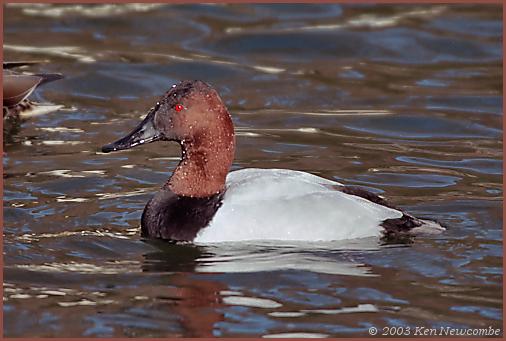
But as I replayed the preceding scene in my mind again, I knew, just KNEW, that the duck I saw on the wing had to be a Wigeon. Cans are so easy to identify - big white, round body, flaming red head, ginormous beak. I just couldn’t believe I had mistaken the two. Could it be that my mind is playing tricks on me and I wanted that duck to be legal so The Friend could get another chance in the closing weeks of the season?

As Max made his way back to the boat, I noticed he had grabbed the duck by the butt and as he swam closer I could see more, and more of that cinnamon head. But as got within a few yards I could begin to make out more details and again saw that unmistakable blue beak.

“What the heck is it?” I said to The Friend. Then is dawned on me. Could it be?

Yes! Indeed, as Max dropped the bird in my hand, I turned and held it up and announced, “Eurasian Wigeon!”

What a treat, particularly for The Friend. I have seen forum posts over the years with hunters who have harvested a Eurasian. And it was last year that I was with The Hunting Partner when he shot his last bird to fill his limit and it was a Eurasian. But to see such a rare bird is special. The Friend and I exchanged high-fives and I began telling him how special this specimen was.

***

Eurasian Wigeon are a rarity among North America waterfowl. Annually there are sporadic sightings and harvest reports along the upper Pacific Coast and Eastern Seaboard. However, they are not native to North America and there is no known breeding population. Eurasians that do make their way into North America come from Siberia or Iceland. On the Pacific Coast it is rare to see one south of Washington State.

Eurasians are one of three types in Wigeon family; American and Chilöe being the other two. American Wigeon are, well, common around here as you would expect. In the Pacific flyway we harvest a lot of American Wigeon. They love to infiltrate the northern California rice field duck clubs where we shoot. Routinely American Wigeon will make up a good portion of a rice field hunter’s bag.

There are no reports of Chilöe Wigeon being spotted or harvested in this area. They inhabit the lower section of southern South America. Although if a Eurasian can get lost and fly to Northern California from Siberia, well then I suppose it is not outside the realm of possibility that a Chilöe could end up here as well.

***

We wrapped up the day talking as excited as school girls about what type of mount The Friend would order to preserve the memory of his rare find. This bird is proof that the duck Gods have a terrific sense of humor. How else can a brand new duck hunter who has only killed two birds in only his first year end up with such a great bird.

As we motored back to the dock, The Friend turned and with a big smile on his face, said “Now that will keep me coming back for a long time.” So true my friend, so true. This is why we live to hunt!

Tuesday, January 13, 2009

Doing the Rain Dance

Oh, the weather outside is… beautiful, sunny, warm, dry. Yesterday the thermometer topped out at 74 degrees. Not exactly what you hope for in the middle of what should be the best waterfowling weather of the season.

This year’s duck season has felt like an absolute roller coaster. One minute we’re complaining because there is no weather and no ducks. The next we’re singing the praises of arctic fronts blowing through and providing wonderful waterfowling action. Now we’re back to complaining. The weather has returned to mid-Spring conditions without the prospect of a drop of rain or snow anywhere in sight.

What is an ongoing irritant for a poor waterfowling season has begun to have larger, more serious consequences. The water conditions in California are downright scary. Coming out of Spring 2008, the snow pack was 24% of average and only 3.4 inches of rain had fallen in the lower regions. Reservoirs were draining faster than they were filling.

By the end of summer most reservoirs and lakes were at record low levels and the State of California declared a major drought for the second year in a row. According to the California Department of Water Resources,

"California is facing the most significant water crisis in its history. After experiencing two years of drought and the driest spring in recorded history, water reserves are extremely low."

So what does this have to do with hunting? Well, no water equals no habitat. No habitat equals no breeding grounds. No breeding grounds equals no breeding. You get the picture. And Northern California counts on a large number of locally grown ducks, particularly mallards, which fill hunter’s bags for a good portion of the waterfowling season.

Additionally, the lack of water combined with a faltering economy and subsidy programs led to a moderate growing season of Northern California’s most important crop – rice. The result is that fewer acres were planted than we’ve seen in over a decade. Rice acreage is critically important for rearing and fueling local breeding mallards.

These same acres are equally as important in the Fall as rice farmers count on flooding rice stubble and leasing those acres to duck hunters for supplemental income and the ducks count on the residual grain as a major winter food source.

Due to water rationing, we have had fewer of those already limited acres flooded this Fall. A large number of hunters lease duck blinds in rice country for an average of $6000 per blind. So the consequence this year was that most rice field duck clubs experienced delayed water deliveries, and in some cases, no water at all.

Yup, believe it or not I had a fellow hunter tell me that the water district that provides water to his club informed the farmer that there would no water this year at all. And there is nothing anyone could do about it. There is simply not enough water to go around. Nobody wins.

I wrote here about my own challenges with our duck club being three weeks late with water. Fortunately we were lucky to get some water, but the water district limited the duration to two weeks instead of the normal thirty days before they shut off the pumps. From then on out we depend on Mother Nature and steady winter rains to keep the fields topped off until the season wraps up at the end of January.

This year that simply has not materialized. Rice fields are drying up all over the Valley and by this time next week our own decoys will be laying on their side in the mud. Ducks don’t hang out in the mud.

What makes me nervous about the beautiful weather we’ve been experiencing is that it will be compounding what is already a very difficult situation. I shutter to imagine what next Fall will bring if the water conditions do not change before the Spring thaw, if there is anything to thaw.

So if you know of an effective rain dance, could you send it to me? If it works, I’m offering a guided duck hunt and all the fixings. Oh, and I’ll even throw in a hug.