"What is today's date?"
"I don't know, November 20th I think."
"Are Specks open?"
"I'm not sure. I think they closed on November 10th."
"I thought they opened on November 10th and closed December 31st?"
"Oh, right, I think that's it."
Meanwhile, the Specks are working like magic and they continue their playful dips and dives getting closer to gunning range.

"Are you Sure?!"
"No."
"No! Dang it, get out your reg book."
"I don't have one, do you?"
Specks are now hovering over the decoys at 15 yards getting more and more suspicious of their motionless mates down below.
"NO! Quick, do you have your cell phone? Call Andy over at the sporting goods store and ask him if Specks are open."
"It's 6:30am, Andy ain't there."
"AArrrggg...."
The Specks now tire of toying with our emotions and lazily float off into the horizon. Silence now abounds in the blind. Finally, The Hunting Partner squeaks out, "Found my reg book..."
Now some of you might say that it is our fault for not having thoroughly read and memorized the waterfowl hunting regulations for the current season. But I actually pride myself on having a photographic memory and am a good steward for reading and understanding the rules of the field before stepping foot out of the truck. But these days, it seems as though you need a Ph.D. in multidisciplinary linguistic composition (yes, I did look that up) to understand the comings and goings of the hunting regulations.
I did some quick 'research' on the internet and found two similar hunting regulations - one from the current 2008/09 waterfowl season that were recently set by the US Fish & Wildlife Service; and the same regulations from 1957.
2008/09 Central Flyway Regulations
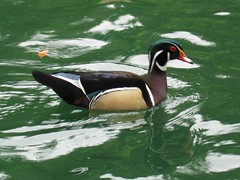
In Montana, Nebraska, Colorado, Oklahoma, and New Mexico, the daily bag limit would be 6 ducks, with species and sex restrictions as follows: mallard -- five, no more than two of which may be females; redhead, scaup, wood duck -- two; pintail, mottled duck, canvasback -- one. For pintails and canvasbacks, the season length would be 39 days, which may be split according to applicable zones/split duck hunting configurations approved for each state. The possession limit would be twice the daily bag limit. In North Dakota, South Dakota, Wyoming, Kansas, and Texas, the daily bag limit would be five ducks, with species and sex restrictions as follows: scaup, redhead and wood duck -- two; only one duck from the following group -- hen mallard, mottled duck, pintail, canvasback. The possession limit would be twice the daily bag.
Contrast this to the 1957 Central Flyway Regulations
The season shall be 75 days, beginning October 1st and ending no later than January 15th. The daily bag limit is 5 with species and sex restrictions as follows: H. Merganser -- one, wood duck -- one. There was also one footnote at the bottom of the table indicating that states choosing a split season would be penalized 10%.

Point made. If I were hunting in any of the states which are articulated in the current regs, I would be extremely nervous about accidental harvest without undertaking a rigorous study of the rules. Even with that, I would keep Andy's phone number on speed dial.
My issue with all this increasing regulatory complexity is that, at least for waterfowl hunting, biologists have been telling us for years that harvest does not negatively impact population levels. Rather, nesting and brooding habitat are the most important factors in determining species success. The current regulatory scheme certainly doesn't support that theory. So why all the complex slicing and dicing by state, species, dates, regions within states, etc., etc.?
When looking at the long term waterfowl population averages, there is further compelling evidence that increasing the detailed breakout of harvest regulations by state and species restriction hasn't necessarily helped increase populations. Pintails are the shining example of this theory. Pintails have been restricted to one for years and still no recovery.
I'm a pretty simple man, hopefully not simple minded, but simple in practice. I enjoy our wildlife resources like most of you and do what I can to help promote and fund their thriving in our wild lands. I play by the rules when I am in the field and trust that the scientists that study wildlife and set those rules have done so with the wildlife's best interest at heart. I just wish that it didn't have to be so dang hard.